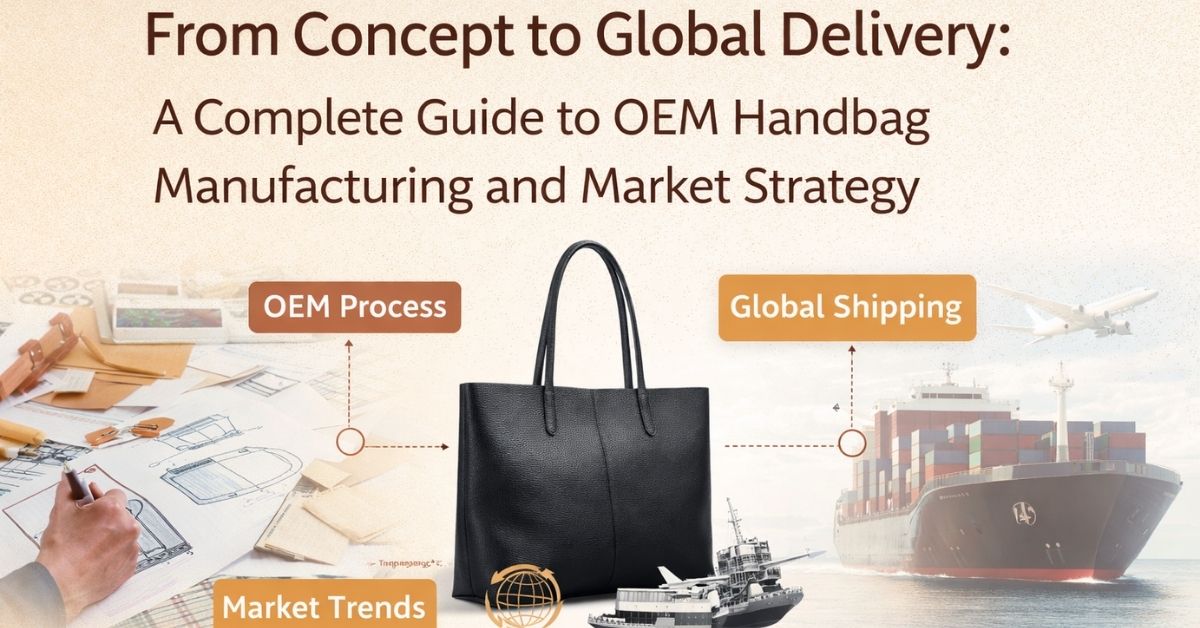

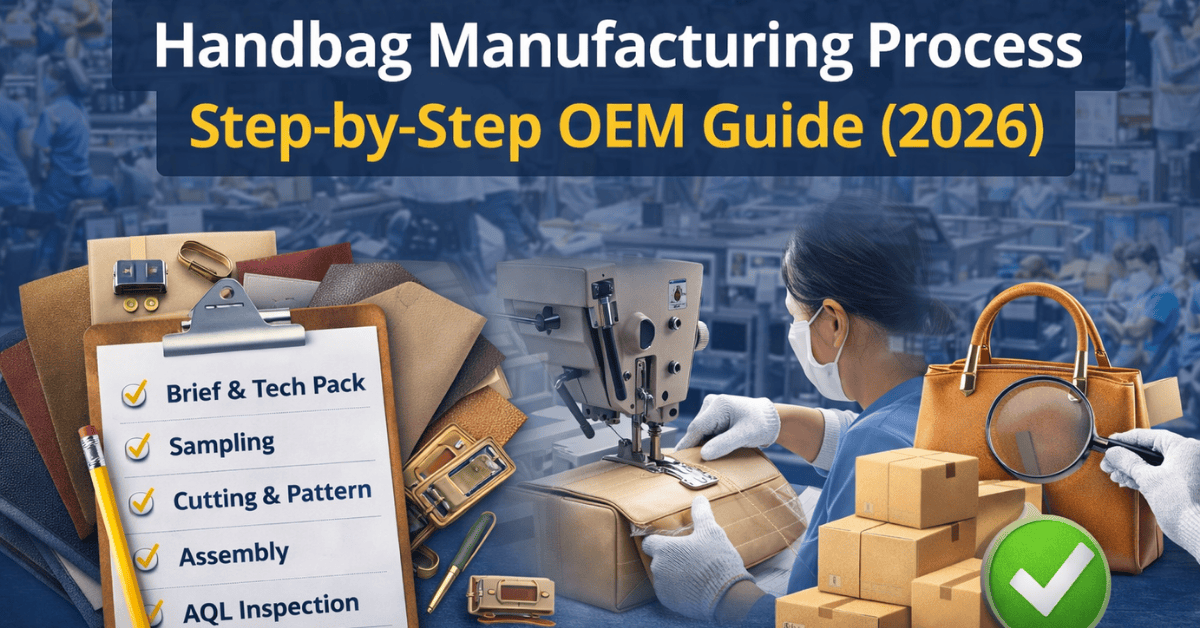
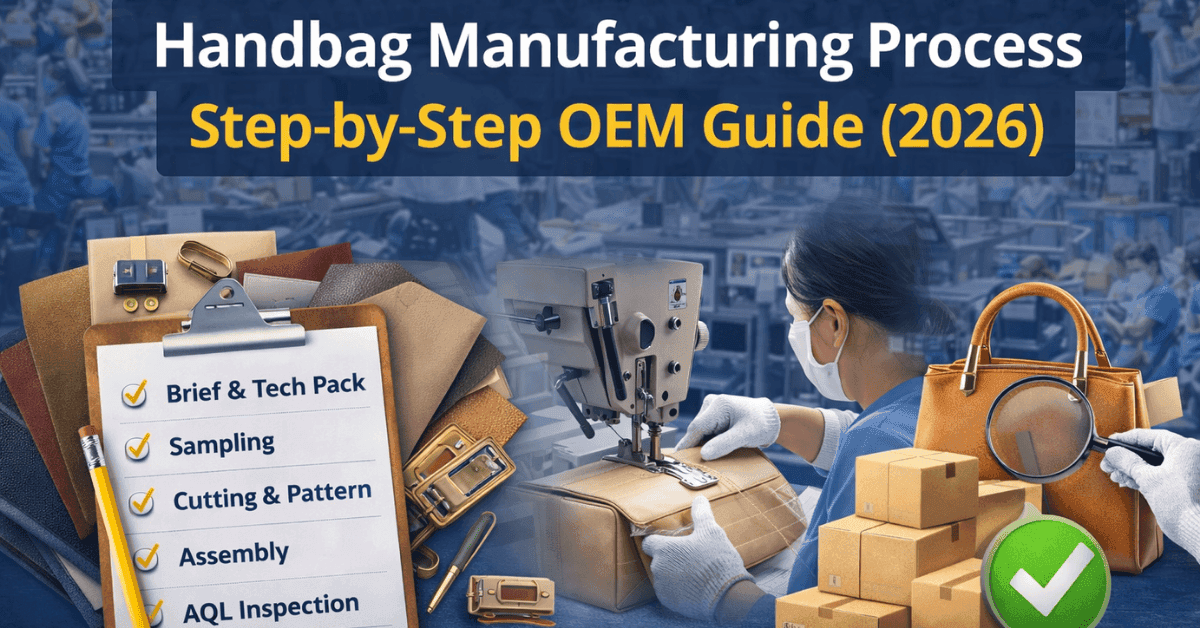
A Factory-Based OEM/ODM Guide for 2026 Buyers
If you’re sourcing a handbag supplier for OEM/ODM or launching a private label collection, understanding the manufacturing workflow helps you:
-
control cost and lead time,
-
avoid sampling mistakes,
-
reduce defect rates,
-
and communicate clearly with your factory.
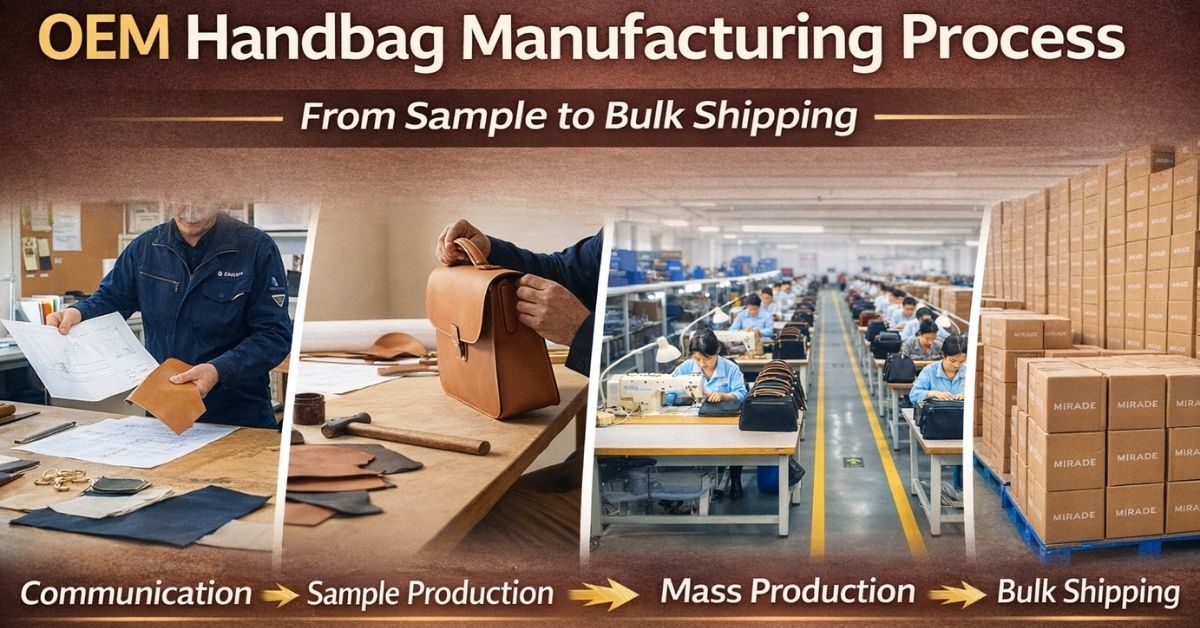
Below is a step-by-step handbag manufacturing process used by professional factories for PU, vegan leather, and genuine leather handbags.
Step 1: Define Your Product Brief (Buyer Inputs)
A factory can only quote accurately if you provide clear specs. Minimum recommended inputs:
-
Bag type (tote, shoulder bag, hobo, bucket bag, backpack, handbag)
-
Target material (PU/vegan leather/genuine leather/nylon/canvas)
-
Target price range & quality level
-
Expected order quantity (MOQ per color/style)
-
Target market compliance requirements (EU/US etc.)
-
Packaging requirements (dust bag, gift box, hang tags)
Pro tip: If you don’t have a full tech pack, a factory can start from a reference sample + photos, but the risk of “not the same” increases.
Step 2: Tech Pack / Spec Sheet (Most Important Document)
A proper tech pack typically includes:
-
Overall dimensions + key panel sizes
-
Material spec (thickness, backing, grain, coating)
-
Lining spec
-
Hardware spec (zipper brand, plating color, logo method)
-
Stitching details (SPI, thread type, seam allowance)
-
Construction notes (reinforcement, foam, base board)
-
Label placement + packaging
This step is where many new brands lose time. A “pretty picture” is not enough—factories build from measurements and construction rules.
Step 3: Material & Hardware Sourcing
The factory sources:
-
Main material (PU/vegan/genuine leather)
-
Lining (polyester/nylon/cotton)
-
Zippers, sliders, pulls (often buyer requests YKK)
-
Buckles, rings, chains, magnetic snaps
-
Webbing, shoulder straps
-
Packaging components
Compliance & risk checks (important for EU/US)
Common buyer-side checks include:
-
REACH Chromium VI restriction for leather articles (EU buyers often ask for this). The widely referenced restriction limit is 3 mg/kg for hexavalent chromium in leather.
-
If you produce children’s items or accessories that fall into regulated categories, US lead limits under CPSIA may apply (e.g., paint lead limits).
Practical meaning: tell your supplier your target market early—material selection and testing plans change the workflow.
Step 4: Pattern Making (Paper Pattern + Cutting Dies)
Pattern making converts design into manufacturable panels:
-
panel shapes + seam allowance
-
reinforcement locations
-
zipper pocket patterns
-
lining patterns
-
strap length rules
For structured handbags, this step is critical because small pattern errors can cause:
-
distortion after turning,
-
bad alignment,
-
uneven top line,
-
or unstable shape.
Step 5: Sampling (Prototype → Revised Sample → Final Approval)
Sampling usually goes through 2–4 rounds:
-
Prototype sample: confirm shape, size, construction
-
Revised sample: adjust materials/hardware/logo placement
-
Salesman sample / pre-production sample (PP): final version for bulk production
-
(Optional) Golden sample: signed reference kept by both sides
What buyers should check during sampling:
-
comfort (strap drop, handle grip)
-
zipper smoothness
-
edge paint quality
-
logo placement + durability
-
stitching alignment
-
smell / material feel
-
weight and stiffness
Step 6: Costing & Quotation Confirmation
Factories typically quote in EXW (Ex-Works). Your bulk price depends mainly on:
-
material cost,
-
hardware complexity,
-
labor time (more pockets/structure = more minutes),
-
packaging,
-
order qty (bulk material purchasing lowers unit cost).
Step 7: Pre-Production Planning (Bulk Readiness)
Before bulk starts, a good factory will:
-
confirm color swatches & material lot
-
lock BOM (bill of materials)
-
set production line SOP (standard operation steps)
-
set QC checkpoints
-
confirm carton marks & packing method
This is also when you should confirm:
-
your shipping terms (EXW/FOB/CIF/DDP),
-
labeling rules (barcode, care label, country of origin).
Step 8: Incoming Quality Control (IQC) for Materials
Factories inspect:
-
material thickness and defects (scratches, wrinkles, color shade)
-
lining shrinkage and dye fastness (if required)
-
zipper function (teeth alignment, slider pull strength)
-
plating consistency for hardware
This prevents “we made 5,000 pcs and the color is off” disasters.
Step 9: Cutting (Die Cutting / CNC Cutting / Manual Cutting)
Cutting must follow grain direction and yield optimization.
For genuine leather, cutting is more complex because:
-
natural scars and loose fiber areas must be avoided
-
cutting yield affects cost heavily
Key controls:
-
panel symmetry
-
notches for alignment
-
batch separation by color/lot
Step 10: Skiving + Edge Preparation
Skiving thins the material at fold lines to reduce bulk:
-
strap folds
-
bag mouth folds
-
corner folds
-
handle wraps
Edge work options:
-
edge paint (multi-layer + drying + sanding)
-
edge oil
-
turned edges (higher-end look)
This step separates “cheap-looking bags” from “premium finish”.
Step 11: Printing / Embossing / Logo Branding
Common branding methods:
-
hot stamping foil logo
-
deboss/emboss
-
metal logo plate
-
woven label
-
heat transfer logo
If custom molds are needed, confirm:
-
mold ownership
-
mold fee
-
lead time
-
maintenance and reuse
Step 12: Sewing & Sub-Assembly
Factories typically sew sub-parts first:
-
zipper pocket units
-
inner compartments
-
strap units
-
handle units
-
piping units
Then merge into the main body.
Critical controls:
-
stitch length consistency
-
seam strength
-
alignment of topstitch lines
-
reinforcement at stress points (strap joints)
Step 13: Assembly + Hardware Installation
Main assembly includes:
-
attaching lining to shell
-
installing zippers and sliders
-
riveting / screwing hardware
-
installing magnetic snaps
-
attaching chains and buckles
-
forming shape with boards/foam (if structured)
Quality checks here focus on:
-
symmetry and shape
-
hardware scratching protection
-
opening/closing smoothness
-
strap strength
Step 14: Final QC + AQL Inspection (Industry Standard Approach)
Most bulk orders follow sampling inspection methods using AQL-based attribute inspection standards such as ISO 2859-1 (commonly referenced in manufacturing QC).
Typical final checks:
-
appearance defects (scratches, stains, wrinkles)
-
stitching defects (skipped stitches, loose threads)
-
edge paint issues (cracking, bubbles)
-
zipper/hardware function
-
measurement tolerance
-
smell and cleanliness
-
packaging correctness
If you’re a buyer: ask your supplier what AQL level they use and whether they support third-party inspection.
Step 15: Packing (Retail-Ready or Bulk Standard)
Common packing options:
-
polybag + silica gel
-
dust bag
-
tissue stuffing to hold shape
-
hang tag + barcode label
-
color box / gift box
-
master carton with shipping marks
Packing matters because damage during shipping often comes from:
-
insufficient stuffing
-
weak cartons
-
poor carton stacking rules
Step 16: Shipping & Logistics
Depending on your terms:
-
EXW: buyer arranges pickup from factory
-
FOB: factory delivers to port
-
CIF/DDP: factory arranges freight (and possibly duties)
For B2B buyers, the factory should provide:
-
packing list
-
commercial invoice
-
carton dimensions/weight
-
HS code guidance (buyer-side final responsibility)
Buyer Checklist: How to Speed Up the Whole Process
If you want faster sampling + fewer revisions, prepare:
-
reference photos + target size
-
target material direction (PU/vegan/leather)
-
hardware finish preference (gold/silver/gunmetal)
-
logo method preference
-
target qty per style/color
-
target market compliance needs (EU/US)
FAQ (Short Buyer Questions You Can Reuse on the Page)
Q1: What is the typical workflow from idea to bulk production?
A: Brief → tech pack → sourcing → pattern → sampling → PP sample → bulk → AQL inspection → packing → shipping.
Q2: Why do factories insist on a pre-production sample?
A: It locks materials, construction, and QC standards so bulk matches the approved reference.
Q3: What standards are commonly used for bulk inspection?
A: Many manufacturers use AQL-style attribute sampling approaches aligned with standards such as ISO 2859-1.